The Principles of Great Programming: How Coaches Build Training That Actually Works
Walk into almost any commercial gym and you'll see dozens of different training programs. Some promise rapid muscle growth. Others promise maximal strength, fat loss, improved endurance, or elite athletic performance. While these programs often look dramatically different on the surface, the best ones share something in common.
They are built upon the same scientific principles.
The difference between effective and ineffective programming is rarely the exercise itself. Rather, it lies in how training variables are organized over time to create a desired adaptation. Great coaches understand that programming is not simply selecting exercises. It is the systematic process of applying the right stress, at the right time, in the right amount, for the right individual.
In many ways, this single idea captures the essence of exercise programming:
Every exercise program is simply an organized manipulation of stress to create a desired adaptation.
Once this concept is understood, programming becomes much less about searching for the perfect exercise and much more about understanding how the human body adapts. Every decision a coach makes—from exercise selection and loading parameters to recovery and progression—should ultimately support a single objective: producing the adaptation that best serves the individual.
Periodization: The Long-Term Blueprint for Adaptation
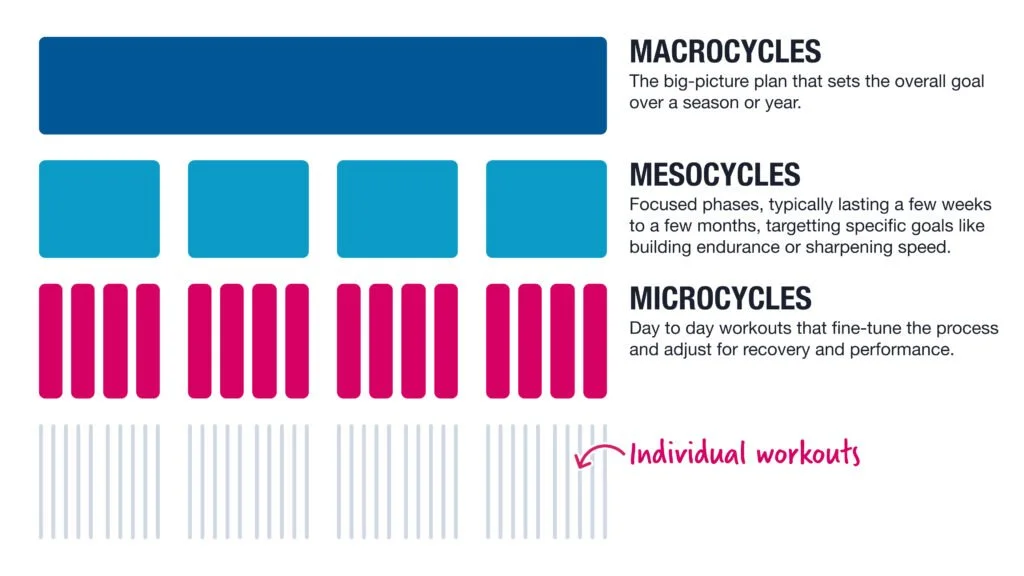
Figure 1. Macrocycles, mesocycles, and microcycles adapted from TrainingPeaks: "Macrocycles, Mesocycles, Microcycles: Periodized Training Explained". Accessed July 5, 2026.
Before discussing the individual components of exercise programming, it is important to understand the concept of periodization. Although the terms programming and periodization are often used interchangeably, they describe different aspects of the training process.
Exercise programming refers to the organization of training variables within a program to produce a desired adaptation. Periodization, on the other hand, is the long-term framework that organizes those programs into logical phases over time. Rather than viewing training as a collection of independent workouts, periodization recognizes that physical qualities develop most effectively when training is sequenced strategically.
At its core, periodization is the planned manipulation of training variables—such as volume, intensity, frequency, exercise selection, and recovery—over weeks, months, or even years to maximize adaptation while minimizing excessive fatigue and reducing the risk of stagnation. It provides structure to the training process, ensuring that each phase builds upon the previous one rather than competing with it.
For example, an athlete preparing for competition may first develop general work capacity and movement competency before progressing toward hypertrophy, maximal strength, power, and ultimately sport-specific performance. Likewise, an individual beginning a resistance training program may initially prioritize learning movement patterns and building tissue tolerance before progressing toward more advanced loading strategies. Although the specific sequence varies depending on the individual and the desired outcome, the underlying principle remains the same: adaptations should be developed in a logical and progressive manner.
This does not mean that training qualities exist in complete isolation. Strength, hypertrophy, power, endurance, mobility, and technical skill often overlap throughout a training cycle. Rather than abandoning one quality to pursue another, effective periodization simply shifts the relative emphasis placed on each adaptation while maintaining previously developed capacities as appropriate.
Ultimately, periodization provides the roadmap, while exercise programming represents the day-to-day decisions that bring that roadmap to life. A periodized plan establishes where an individual is going and when different qualities should be emphasized. Programming determines how each training session is organized to move them toward that destination.
Understanding this distinction provides an important perspective for the remainder of this article. Every workout, every exercise, and every programming decision should be viewed not as an isolated event, but as one deliberate step within a much larger process of long-term adaptation.
Programming Is More Than Writing Workouts
One of the most common misconceptions is that exercise programming simply means creating workouts. While workouts are certainly part of the process, they represent only a single training session. A program is much broader. It is a long-term strategy that organizes training sessions over weeks, months, and sometimes years to progressively move an individual toward a specific goal.
Exercises are simply tools. Programming is the process of deciding when, why, and how those tools should be used.
This distinction is important because the human body does not recognize exercises. It recognizes stress. Whether that stress comes from a heavy squat, a sprint, a loaded carry, or a medicine ball throw is less important than the physiological demand placed upon the body. In response, the body remodels itself according to the demands it repeatedly encounters. This principle explains why two individuals may perform entirely different exercises yet develop similar physical qualities when the underlying training stimulus is appropriate.
The role of the coach, therefore, is not merely to prescribe exercises. It is to organize stress in a way that consistently moves the individual toward the desired adaptation while respecting their current capacity to recover.
Adaptation Is the Goal
Every training session creates physiological stress. The body continually evaluates whether that stress is sufficient to require change.
If the stimulus is too small, little meaningful adaptation occurs. If the stimulus is appropriate and followed by adequate recovery, the body becomes stronger, more efficient, more resilient, or more aerobically fit depending on the nature of the training. If the stress exceeds the individual's capacity to recover, fatigue accumulates faster than adaptation can occur, increasing the likelihood of stagnation, declining performance, or injury.
Programming is the process of consistently placing someone in that optimal middle ground where stress is sufficient to challenge the body without overwhelming its ability to recover.
This is an important shift in perspective. Training itself does not make someone stronger. Training provides the stimulus. Adaptation occurs afterward through the biological processes of recovery. Understanding this relationship fundamentally changes how coaches think about progression, fatigue management, and long-term program design.
The Principles That Govern Every Great Program
Although training goals may differ substantially, the principles that govern effective exercise programming remain remarkably consistent. Whether the objective is increasing maximal strength, building muscle mass, improving endurance, enhancing athletic performance, or returning someone to activity following injury, every successful program is built upon the same physiological foundations. These principles provide the framework that allows coaches to make intelligent programming decisions regardless of the individual sitting in front of them.
Specificity
The principle of specificity serves as the foundation of all programming. Often referred to as the SAID Principle—Specific Adaptation to Imposed Demands—it describes the body's ability to adapt specifically to the stresses it repeatedly experiences.
Heavy resistance training improves maximal force production because the neuromuscular system is repeatedly challenged to generate high levels of force. Explosive training develops power because the nervous system adapts to producing force rapidly. Endurance training improves aerobic capacity because the cardiovascular and metabolic systems are consistently exposed to prolonged work. The body does not randomly decide what to improve; it adapts according to the demands placed upon it.
Specificity extends beyond simply selecting exercises. Movement velocity, range of motion, contraction type, force vectors, energy system demands, and even technical skill all influence the adaptations that occur. For this reason, every program should begin by asking a simple question: What adaptation am I trying to create? Once that answer is clear, every subsequent programming decision should support it.
Progressive Overload
Once the desired adaptation has been identified, the next responsibility of the coach is to ensure that the stimulus continues to challenge the body over time. This is the purpose of progressive overload.
Contrary to popular belief, progressive overload is not synonymous with adding weight to the bar every week. Training stress can be increased by manipulating numerous variables including training volume, intensity, frequency, movement complexity, exercise selection, range of motion, work density, movement velocity, technical demands, or proximity to failure. Each of these variables changes the stress experienced by the body and therefore influences adaptation.
Perhaps more importantly, progressive overload should not be confused with simply making training harder. More fatigue does not necessarily produce greater results. The objective is to provide enough stress to stimulate adaptation while remaining recoverable. Particularly in experienced athletes, progression often becomes increasingly subtle, occurring through improvements in movement quality, technical efficiency, or small increases in workload accumulated consistently over time.
Individualization
No two individuals respond identically to the same training program. Genetics, training age, injury history, movement competency, recovery capacity, occupational stress, sleep quality, and personal goals all influence how someone adapts to exercise.
This is one of the primary reasons generic programs produce inconsistent outcomes. While two individuals may share the same goal of increasing strength, the amount of stress required to produce adaptation may differ substantially. A novice lifter often progresses with relatively modest training volumes, whereas an experienced athlete may require significantly greater workloads to continue improving.
Individualization also extends beyond physiology. The most scientifically sound program is ineffective if it cannot be performed consistently because it exceeds the individual's available time, recovery resources, or motivation. Effective programming always balances evidence with practicality, recognizing that consistency is ultimately more valuable than perfection.
Variation
Variation is often mistaken for constantly changing exercises to keep training exciting. In reality, effective variation is purposeful rather than random.
As the body adapts, the same training stimulus gradually produces smaller improvements. Strategic variation allows coaches to continue exposing athletes to meaningful challenges while managing fatigue, reducing repetitive loading, and addressing evolving performance needs. This may involve altering training volume, intensity, exercise selection, or movement emphasis while preserving the overall objective of the program.
Excessive novelty can actually interfere with long-term progress by preventing adequate practice of fundamental movement patterns and making progression difficult to measure. Great coaches understand that variation should support progression rather than replace it. The goal is not to create a different workout every week. The goal is to continue producing meaningful adaptation.
Recovery
Recovery is not separate from training; it is an essential component of training itself.
Every training session produces both fitness and fatigue. While the workout provides the stimulus for change, the physiological processes responsible for building stronger muscles, connective tissue, cardiovascular capacity, and neuromuscular efficiency occur during recovery. Sleep, nutrition, hydration, psychological stress, and appropriate management of training load all influence how effectively the body responds to exercise.
This relationship is often described through the Fitness-Fatigue Model, which recognizes that improvements in performance depend on maximizing long-term fitness while strategically managing fatigue. Programs that consistently exceed an individual's ability to recover eventually reduce performance regardless of how well designed the workouts appear on paper.
For this reason, great programming is never simply about prescribing hard training. It is about balancing stress with recovery so that adaptation can occur repeatedly over months and years.
The Variables Coaches Manipulate
Once these foundational principles are understood, programming becomes the deliberate manipulation of training variables. Rather than asking which exercise is best, coaches begin asking which variables need to change to create the desired physiological response.
Training frequency determines how often a stimulus is applied. Volume influences the total amount of work performed and is one of the primary drivers of muscular adaptation. Intensity reflects both the external load being lifted and the internal effort required to perform the work. Rest intervals, movement tempo, exercise order, range of motion, and exercise selection each modify the stress experienced by the athlete in different ways.
Importantly, no single variable exists in isolation. Increasing training volume may require reducing intensity. Shortening rest periods changes the metabolic demands of the session. Selecting a more technically demanding exercise may require lowering external load while increasing motor control demands. Great programming involves understanding how these variables interact to produce a cohesive training stimulus rather than manipulating them independently.
Programming for Different Adaptations
Although the principles remain constant, the emphasis placed on different programming variables changes depending on the desired outcome. Strength development prioritizes high force production, heavier loading, technical proficiency, and adequate recovery between sets. Hypertrophy programming emphasizes sufficient weekly training volume, mechanical tension, and proximity to failure while maintaining an appropriate balance between stimulus and recovery.
Power development shifts the focus toward movement velocity and intent, recognizing that the ability to produce force rapidly often matters more than simply producing large amounts of force. Endurance training emphasizes aerobic development, fatigue resistance, and movement economy, while resistance training serves as a valuable complement by improving force production and reducing the relative cost of movement.
Athletic development presents an even greater challenge because athletes rarely require only one physical quality. Programs must integrate strength, power, speed, conditioning, movement skill, and recovery into a cohesive plan that evolves throughout the competitive calendar.
How Great Coaches Think
Perhaps the greatest distinction between experienced coaches and beginners lies in the questions they ask.
Beginners often ask, "What exercises should I do?"
Experienced coaches begin somewhere entirely different. They first identify the adaptation they are trying to create. Next, they determine what currently limits that adaptation. From there, they select the type of stress most likely to address that limitation, choose exercises capable of delivering that stress, determine the appropriate training dose, monitor progress, and continually adjust the program as the individual adapts.
Exercise selection becomes the final step rather than the starting point.
Programming, therefore, is not the process of organizing workouts. It is the ongoing process of solving human performance problems through the intelligent application of training principles.
Final Thoughts
Successful exercise programming is not about discovering secret exercises, perfect repetition ranges, or the latest training trend. It is about understanding how the human body responds to stress and using that knowledge to guide long-term decision making.
Every programming decision should ultimately answer one question:
Does this help create the adaptation I am trying to achieve?
When coaches understand this concept, programming becomes far less about copying templates and far more about applying timeless scientific principles to the individual standing in front of them.
Exercises are tools.
Adaptation is the goal.
Programming is the process that connects the two.
Whether your goal is strength, hypertrophy, endurance, athletic performance, or lifelong health, the same truth remains:
Every exercise program is simply an organized manipulation of stress to create a desired adaptation.